


What You Need to Know Before You Apply for Section 8
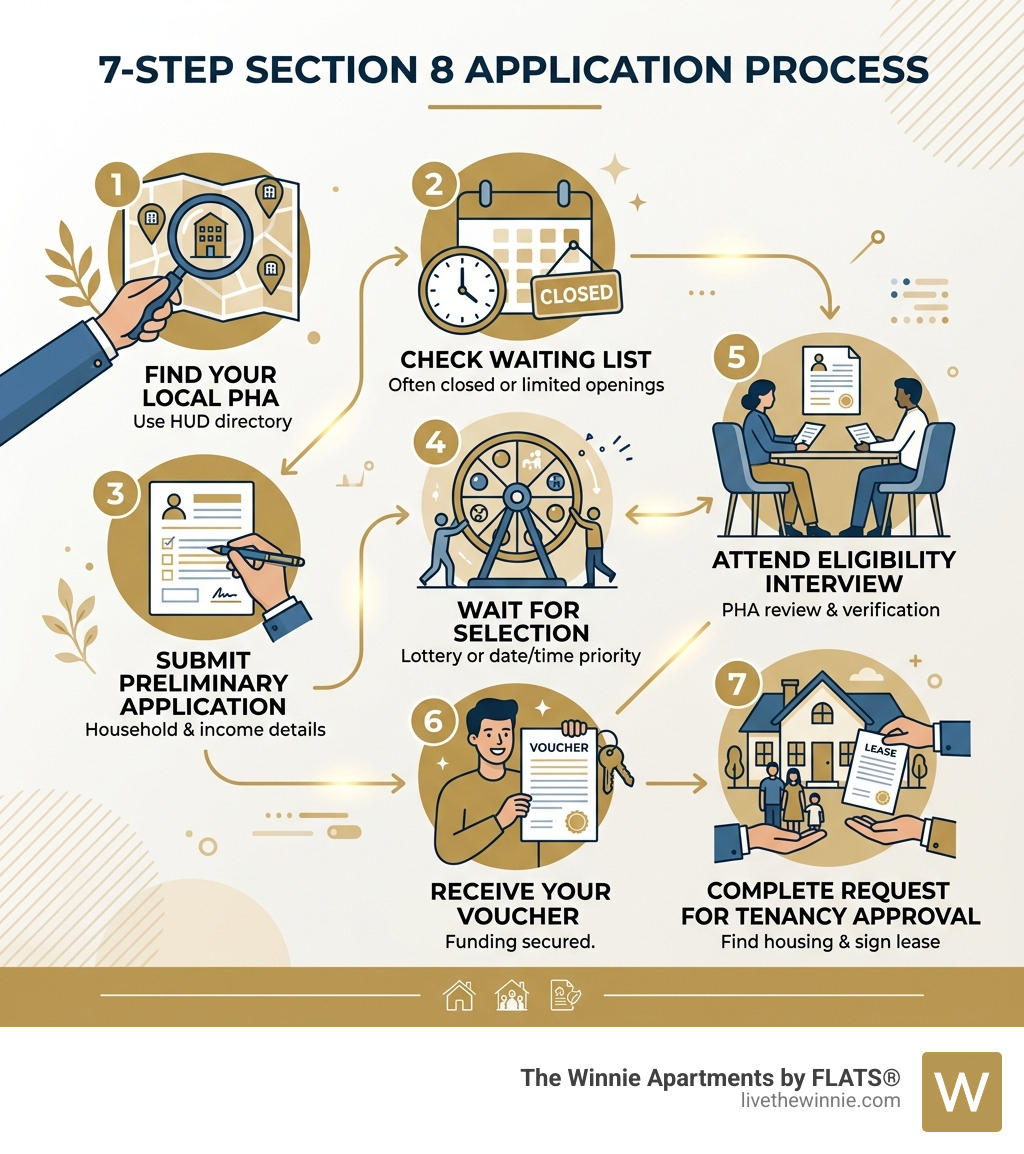
If you want to apply for Section 8, here is the short answer:
- Find your local Public Housing Agency (PHA) using HUD's online directory
- Check if a waiting list is open — many are closed or open only briefly
- Submit a preliminary application with basic household and income information
- Wait for selection — either by lottery or date/time received
- Attend an eligibility interview when contacted by the PHA
- Receive your voucher and begin searching for qualifying housing
- Complete the Request for Tenancy Approval with your chosen landlord
The Section 8 Housing Choice Voucher Program is run by the U.S. Department of Housing and Urban Development (HUD) and managed by roughly 2,000 local Public Housing Agencies across the country. It helps eligible households pay rent in private housing — apartments, townhomes, single-family homes — not just government-owned buildings.
Demand is high. Waiting lists are long. Some close within days of opening.
Knowing how the process works before you start can save you time, stress, and missed opportunities.
Understanding the Process to Apply for Section 8

Navigating the federal housing landscape can feel like trying to solve a giant puzzle. However, once we break down the mechanics, the path becomes much clearer. To successfully apply for Section 8, we must first understand that this is a partnership between the federal government, local agencies, and private landlords.
The program is designed to provide residents with choices. Unlike traditional public housing, where you are assigned to a specific building, the Housing Choice Voucher (HCV) program allows us to find a home that fits our lifestyle. Whether that is a modern studio in Uptown Chicago or a larger apartment near local attractions, the voucher moves with the tenant. For more information on how these programs integrate with local communities, you can explore Section 8 housing | USAGov or look into Apartments Near Me.
Defining the Housing Choice Voucher Program
The Housing Choice Voucher Program is the federal government's major initiative for assisting eligible families, the elderly, and the disabled. HUD provides the funding, but the day-to-day operations are handled by local Public Housing Agencies (PHAs).
The "choice" in the name is the most important part. When we receive a voucher, we are responsible for finding a suitable housing unit where the owner agrees to rent under the program. This can include the very same apartments we see every day in our neighborhoods. The PHA pays a housing assistance payment directly to the landlord on behalf of the family, and the family then pays the difference between the actual rent charged by the landlord and the amount subsidized by the program.
How to Find Your Local Public Housing Agency
To get started, we need to identify which agency manages the vouchers in our specific area. In the Chicago area, this is primarily handled by the Chicago Housing Authority (CHA) and the Housing Authority of Cook County (HACC).
Each PHA has its own jurisdiction and its own set of rules for how they manage their waiting lists. It is vital to use the official HUD PHA search tool to find the contact information for the office serving Uptown Chicago. You can find detailed guidance on navigating these local agencies at How to Apply for a Section 8 Housing Choice Voucher. We aren't limited to just one; we can often apply to multiple agencies if their lists are open, though we must be prepared to live in the jurisdiction of the agency that issues the voucher.
Eligibility Requirements for Voucher Applicants

Before we spend time on the application, we need to ensure we meet the basic criteria set by HUD. Eligibility is determined by the PHA based on the total annual earnings and family size. It is also limited to U.S. citizens and specified categories of non-citizens who have eligible immigration status.
In general, the family's earnings may not exceed 50% of the Area Median Income (AMI) for the county or metropolitan area where the family chooses to live. By law, a PHA must provide 75 percent of its vouchers to applicants who meet the program's most specific financial criteria. You can check how these standards apply to specific demographics by visiting HUD Senior Housing Chicago.
Income Limits and Household Composition
When we apply for Section 8, the PHA will look at every source of earnings for every adult in the household. This includes wages, Social Security benefits, pensions, and even interest from assets.
Household composition is also a major factor. A "family" can be a single person or a group of people living together. The PHA will verify the size of the household to determine the appropriate voucher size (e.g., a one-bedroom voucher for a single person or a couple). During the application process, we will need to provide documentation for everyone living in the home to ensure the assistance level is calculated correctly.
Citizenship and Background Check Standards
To be eligible, at least one member of the household must be a U.S. citizen or have eligible immigration status. If only some members are eligible, the assistance may be "prorated," meaning the subsidy is adjusted based on the number of eligible people.
Background checks are a standard part of the process. While many people with a criminal history can still qualify, there are two "lifetime" bans mandated by federal law:
- Any household member who has ever been convicted of drug-related criminal activity for manufacture or production of methamphetamine on the premises of federally assisted housing.
- Any household member who is subject to a lifetime registration requirement under a state sex offender registration program.
PHAs also have the discretion to deny assistance if there is a recent history of violent criminal activity or drug-related activity that might threaten the safety of other residents.
Navigating the Waiting List and Selection
Because the demand for housing assistance often exceeds the limited resources available to HUD, long waiting periods are common. In fact, many PHAs close their waiting lists for years at a time. When a list does open, it is often only for a few days.
To stay ahead, we should regularly check the How to Register & Submit an Application Online – HACC portal or the CHA website. Many agencies have moved to a lottery system to ensure everyone has a fair chance, regardless of when they submitted their application during the open window.
How Waiting Lists Work for Section 8 Applications
When a PHA opens its list, they will issue a public announcement. We then submit a "pre-application." This is a short form that asks for basic details like name, address, income estimate, and family size.
Once the window closes, the PHA establishes the waitlist. If they use a lottery, they will randomly select a set number of applicants from the pool to be placed on the active list. If you are not selected in the lottery, you usually have to wait until the next time the list opens to try again. For those who are selected, the PHA will provide a confirmation number which we must keep safe.
Preferences and Status Maintenance
Many PHAs use "local preferences" to move certain people to the top of the list faster. Common preferences include:
- Families who are currently homeless.
- Veterans or surviving spouses of veterans.
- People who already live or work in the PHA's jurisdiction (like Uptown Chicago).
- Victims of domestic violence.
It is absolutely crucial to keep our contact information updated. If the PHA sends a letter or email and we don't respond within their timeframe (often 10 business days), they will remove us from the list entirely. You can see how large-scale agencies handle these updates at Apply - NYCHA, which serves as a good example of the strict notification rules.
Steps to Take After You Apply for Section 8
Once we reach the top of the waiting list, the real work begins. The PHA will contact us to schedule an eligibility interview. This is the "final exam" of the application process where every piece of information we provided is verified with hard evidence.
The Eligibility Interview and Documentation
We should arrive at the interview prepared with a folder containing:
- Social Security cards for all household members.
- Birth certificates for everyone.
- Photo IDs for all adults.
- Proof of all earnings (pay stubs, tax returns, benefit letters).
- Bank statements.
- Proof of any local preferences we claimed.
If any information is missing, it can delay the issuance of the voucher. All adult household members are typically required to attend this meeting.
Voucher Issuance and the Housing Search
If the interview goes well, we will attend a briefing where we are officially issued our voucher. This document tells us the maximum rent the PHA will cover and the size of the unit we can look for.
We generally have between 60 to 120 days to find a place. This can be a stressful time, but we can request extensions if we show we are actively looking. Once we find a home—perhaps a sleek studio in a neighborhood like Uptown—we and the landlord fill out a "Request for Tenancy Approval" (RFTA). The PHA then inspects the unit to ensure it meets Housing Quality Standards (HQS). If it passes, and the rent is deemed reasonable, the lease can be signed.
How to Apply for Section 8 in Chicago
In our local area, the CHA's Waitlist Portal – Apply - Chicago Housing Authority is the primary hub for those looking to live within the city limits. The CHA often manages separate lists for different types of housing, so we must ensure we are applying for the "Housing Choice Voucher" specifically if we want the flexibility to choose our own apartment.
Uptown is a popular area for voucher holders because of its vibrant community and access to transit. When searching, we should look for buildings that emphasize community living and quality finishes, as many private landlords in this area are familiar with the voucher process.
Portability and Your Rights as a Tenant
One of the best features of the Section 8 program is "portability." This is the feature that allows us to take our voucher and move to another part of the country, provided there is a PHA in that area to administer it.
Moving with Your Voucher
If we lived in the jurisdiction of the PHA when we first applied, we can usually use the portability feature immediately. However, if we did not live in the area when we applied, the PHA may require us to live in their jurisdiction for the first 12 months before we can "port" out.
The process involves our current PHA (the "initial" agency) sending our file to the PHA in the new area (the "receiving" agency). The receiving agency's rules for voucher size and payment standards will then apply to us. This gives us the freedom to move for job opportunities or to be closer to family without losing our housing assistance.
Common Reasons Applications to Apply for Section 8 are Denied
It is heartbreaking to go through the whole process only to be denied. Common reasons include:
- Income Limits: Our income increased while we were on the waitlist and now exceeds the limit.
- Criminal Record: A background check revealed a disqualifying offense.
- Debts: We owe money to a PHA from a previous tenancy in subsidized housing.
- Misinformation: Providing false information on the application is considered fraud and is a ground for immediate denial.
If we are denied, the PHA must send a written notice explaining why. We have the right to request an "informal review" to contest the decision.
Frequently Asked Questions about Section 8
How long does the application process take?
There is no single answer, as it depends entirely on the local PHA's funding and the length of their waitlist. In high-demand areas like Chicago, it is not uncommon to wait several years. However, if a PHA uses a lottery for a new list, some applicants might be selected and processed within a few months.
Can I apply to multiple waiting lists?
Yes! In fact, we recommend it. As long as a waiting list is open and you are willing to live in that jurisdiction for at least a year, you can apply to as many PHAs as you like. Just remember that each one is a separate entity; being on the list for the CHA does not mean you are on the list for the HACC.
How do I check my application status?
Most modern PHAs use online self-service portals. When we apply for Section 8, we are usually given a login or a confirmation number. We should log in periodically to ensure our application is still "active." If the agency doesn't have a portal, we can contact their Customer Contact Center, though wait times on the phone can be long.
Conclusion
Finding the right home is about more than just four walls; it’s about finding a community where we can thrive. Whether you are looking for the modern energy of Uptown Chicago or a quiet place to call your own, the Section 8 program is a powerful tool to help you get there.
At The Winnie Apartments by FLATS®, we understand the importance of comfort and convenience. Our modern studio and one-bedroom apartments in Uptown are designed for those who value community living and easy access to the best the city has to offer. While the voucher process requires patience and persistence, the reward of a stable, beautiful home is worth the effort. For more resources on your journey, Explore Apartments Near Me and take the next step toward your future.