


What Is a ZIP+4 Code — and Why Does It Matter?
Doing a zip code plus 4 lookup takes less than a minute, and the steps are straightforward:
- Go to the USPS ZIP Code lookup tool at tools.usps.com
- Enter your full street address, city, and state
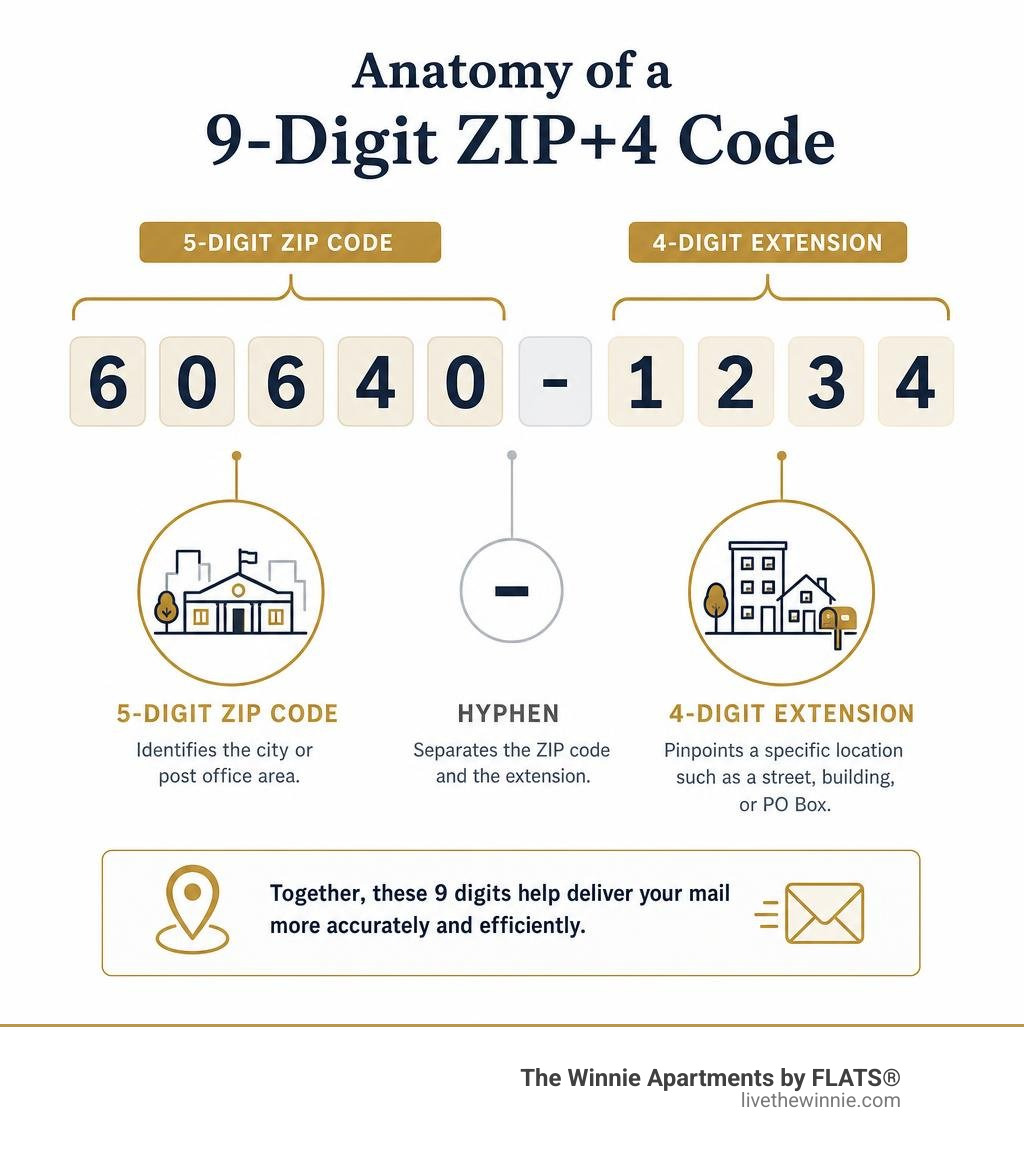
- Read your 9-digit ZIP code — it appears as five digits, a hyphen, then four more (e.g., 60640-1234)
That's it. The full 9-digit result is your ZIP+4 code.
Most people know their 5-digit ZIP code by heart. Far fewer know about the extra four digits sitting right after the hyphen — and even fewer realize how much those four digits actually do.
The standard 5-digit ZIP code gets your mail to the right post office. The ZIP+4 extension narrows it down further — to a specific block, building, or even a single PO Box. That added precision helps the USPS sort and route mail faster, and it can shave up to two days off delivery time compared to using only a 5-digit code.
With over 44 million ZIP+4 codes assigned across the US, and roughly 5% of all addresses getting their ZIP+4 changed every month, knowing how to look yours up — and keep it current — matters more than most people expect.
What is a ZIP+4 Code and How Does It Work?
To understand how a zip code plus 4 lookup works, it helps to understand the history of how our mail is routed. The United States Postal Service (USPS) first introduced the Zone Improvement Plan (ZIP) code on July 1, 1963. The goal was simple: make mail sorting more efficient to handle the massive post-war boom in paper mail.
The original 5-digit ZIP code was a massive success, but as populations expanded and cities grew denser, the USPS needed a way to sort mail with even greater precision. This led to the introduction of the ZIP+4 code in 1983.
A standard 5-digit ZIP code gets your mail to a general delivery area or a local post office. The 9-digit ZIP code (often called ZIP9) takes that delivery process to a micro-level.
Here is how the numbers break down:
- First Digit: Represents a broad geographic area of the United States (for example, "6" covers Illinois, Missouri, Nebraska, and Kansas).
- Second and Third Digits: Represent a specific central post office or sectional center facility (SCF) that processes mail for that region.
- Fourth and Fifth Digits: Represent a specific local post office, delivery area, or neighborhood station.
- Sixth and Seventh Digits (The Sector): Identify a specific geographic sector, such as a group of streets, a large office building, or a specific block.
- Eighth and Ninth Digits (The Segment): Identify an even smaller segment within that sector, such as one side of a street, a specific floor in a high-rise, or a specific cluster of mailboxes.
This incredible level of detail means that instead of a mail carrier manually sorting letters for an entire neighborhood, automated sorting machines can organize mail in the exact order of the carrier's walking or driving route.
While a typical ZIP+4 code covers an average of 4.1 delivery points (excluding PO Boxes), it can represent anywhere from 6 to 20 delivery points on a standard carrier route. However, PO Boxes are a unique exception. Across the United States, there are 7,282,402 dedicated PO Box ZIP+4 codes. In these cases, there is typically one unique ZIP+4 code assigned to each individual PO Box, meaning your extra four digits will often match your actual box number.
To see how these two systems compare side-by-side, look at the table below:
| Feature | Standard 5-Digit ZIP Code | ZIP+4 Code (9-Digit ZIP) |
|---|---|---|
| Year Introduced | 1963 | 1983 |
| Total Codes in US | 39,969 | 44,255,314 |
| Geographic Precision | Broad region or local post office area | Specific block, building, or PO Box |
| Average Delivery Points | Thousands of addresses | 4.1 delivery points (1 per PO Box) |
| Delivery Speed | Standard processing | Up to 2 days faster |
| Commercial Mail Discount | No | Yes (when combined with barcodes) |
For a deeper dive into how these codes were created and how they operate behind the scenes, you can read the comprehensive guide on ZIP+4 Code lookup | Get last 4 digits of 9-digit ZIP Codes - Smarty.
How to Find Your 9-Digit ZIP Code in 3 Simple Steps
Whether you are sending a single important package or cleaning up a customer database for a local business, performing a lookup is incredibly easy. The process involves address validation and standardization to ensure that the USPS database recognizes your location.

Here is how you can find any 9-digit ZIP code in three simple steps.
Step 1: Choose a Reliable Zip Code Plus 4 Lookup Tool
The first step is to select a lookup tool that connects directly to official USPS data. While there are many third-party tools available, using a CASS-certified (Coding Accuracy Support System) tool ensures you get the most accurate, up-to-date data.
For quick, individual address searches, the official ZIP Code™ Lookup | USPS is the gold standard. If you want a fast, developer-friendly alternative that also offers API access, you can use the Free ZIP+4 Lookup Tool - USPS ZIP Plus Four Finder.
Step 2: Enter Your Complete Street Address
To get an accurate 9-digit ZIP code, you must enter the complete address. Leaving out details like apartment numbers, suite designations, or directional indicators (like North or West) can prevent the tool from finding the correct +4 extension.
When typing your address, make sure to include:
- Street Address: Include the house number and full street name (e.g., "4601 N Broadway").
- Unit Number: Always include the apartment, suite, or unit number (e.g., "Apt 302").
- City and State: Enter the full city name and state abbreviation (e.g., "Chicago, IL").
- PO Box Formatting: If you are looking up a PO Box, place the PO Box number directly in the street address field (e.g., "PO Box 409").
Step 3: Retrieve and Verify Your Standardized Address
Once you click search, the lookup tool does more than just find four numbers. It standardizes your address to match the official USPS format. This process, known as Delivery Point Validation (DPV), confirms whether the address is a real, physical delivery point that can receive mail.
The tool will return:
- Your Standardized Address: Abbreviations will be corrected (e.g., "Broadway Street" becomes "BROADWAY ST").
- The ZIP+4 Code: The complete 9-digit code will be displayed.
- Carrier Route ID: The specific route code used by the local mail carrier.
Why You Need a Zip Code Plus 4 Lookup for Accurate Mailings
Using a 9-digit ZIP code is about more than just being precise—it is about ensuring your mail actually reaches its destination.
In FY 2023, nearly 4.37 billion pieces of mail were undeliverable, representing roughly 4.4% of the total mail volume. This massive amount of lost and returned mail cost mailers more than $1.3 billion. Most of these delivery failures were caused by simple address errors, missing apartment numbers, or outdated ZIP codes.
By using a zip code plus 4 lookup, you significantly reduce the risk of misdelivered, returned, or delayed mail. This is especially true in dense urban neighborhoods. For example, if you are sending mail to our neighborhood in Chicago, understanding local postal boundaries is essential. You can explore the Uptown Chicago Zip Code Guide 2026 to see how local routes are distributed across the 60640 area.
For organizations that manage large mailing lists, using tools like the Address Information System (AIS) Viewer | PostalPro is a smart way to retrieve, view, and print accurate ZIP code data for all 50 states, ensuring your address records remain highly accurate.
How Businesses Benefit from a Zip Code Plus 4 Lookup
For businesses, maintaining clean address data is a major competitive advantage. If your company sends bulk mailings, catalog distributions, or billing statements, using ZIP+4 codes is the key to unlocking commercial mailing discounts.
The USPS offers presort discounts ranging from 5% to nearly 60% for mailings that include accurate ZIP+4 codes and delivery point barcodes. Because the mail is already sorted to the carrier level before it even arrives at the post office, the USPS passes those labor savings back to your business.
To manage this at scale, you do not have to look up addresses one by one. You can easily Find ZIP+4 for an Address (or Millions of Them) | Geocodio by uploading a CSV or Excel spreadsheet. Their batch processing tools and APIs allow you to append ZIP+4 data, carrier routes, and congressional districts to your entire customer database instantly.
The Difference Between ZIP+4 and ZIP+6 Delivery Points
As you dive deeper into address validation, you might encounter the term "ZIP+6." While it sounds like a completely different system, it is actually the next logical step in postal precision.
- ZIP+4 (9 Digits): Narrows your address down to a small geographic segment, such as a specific block or a multi-unit building.
- ZIP+6 (11 Digits): Also known as a delivery point code, this system adds two more digits to the end of your 9-digit ZIP code. These extra digits correspond to your exact physical mailbox.
In a large apartment building with dozens of units, the entire building might share a single ZIP+4 code. However, each individual apartment has its own unique ZIP+6 delivery point code. This level of household precision allows automated sorting machines to organize mail down to the specific mailbox, ensuring high accuracy and preventing mix-ups in shared mail areas.
Frequently Asked Questions about ZIP+4 Codes
Managing address databases and understanding postal guidelines can raise a few questions. Here are the answers to some of the most common questions about ZIP+4 codes.
How often do ZIP+4 codes change?
Many people assume that once a ZIP+4 code is assigned to an address, it never changes. In reality, about 5% of all ZIP+4 codes change every single month.
These changes happen because the USPS constantly reorganizes its carrier routes to adjust for new housing developments, changing population densities, and postal worker workloads. To keep your business database accurate, you must update your records regularly. Businesses can license the official ZIP + 4® Product | PostalPro to access the complete database of over 30 million records and receive monthly transaction updates.
What are the limitations of free lookup tools?
While free online lookup tools are perfect for checking an individual address, they have clear limitations for business use:
- Rate Limits: Most free tools restrict the number of searches you can perform in a single day.
- No Bulk Processing: You cannot upload spreadsheets or process thousands of addresses at once.
- No Automation: Free web tools cannot be integrated into your online checkout system or CRM to validate addresses in real-time.
Does every address have a unique ZIP+4 code?
No. A ZIP+4 code typically represents a small group of delivery points, such as a side of a street block or a floor of an office building. This means you will likely share your ZIP+4 code with several of your immediate neighbors. The only major exception is PO Boxes, where each box is usually assigned its own unique ZIP+4 code.
Conclusion
Finding and using your 9-digit ZIP code is one of the simplest ways to ensure your mail, packages, and deliveries arrive quickly and safely. Whether you are validating a single address or managing a large database, a quick zip code plus 4 lookup makes all the difference.
If you are looking to make your home in a vibrant, connected neighborhood, accurate routing is just the beginning of a smooth move. At The Winnie, we offer modern studio and one-bedroom apartments in Uptown Chicago. Our community combines comfortable, convenient apartment living with easy access to the local transit, dining, and culture that makes our neighborhood so unique.
Whether you are updating your shipping address, setting up your local utilities, or exploring the neighborhood, we are here to help you feel right at home. To learn more about our local area and boundaries, check out our guide to the Uptown Zip Code.